The Death of the Traditional Web: Why 99% of Websites Will Become Invisible
The human browsing era is peaking. As autonomous AI agents take over web interaction, legacy frameworks face a Y2K-level architectural crisis.
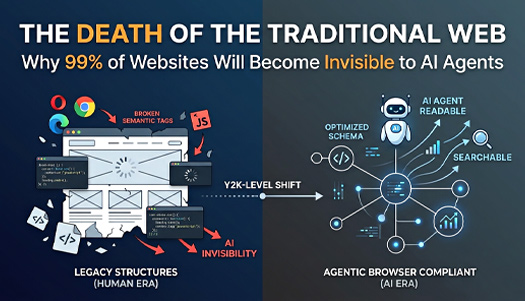
The human browsing era is peaking. As autonomous AI agents take over web interaction, legacy frameworks face a Y2K-level architectural crisis.
The internet is heading toward a Y2K-level architectural crisis, and almost nobody is talking about the real problem.
Everyone is busy building “AI features,” wrapping LLMs into plugins, and forcing chatbots onto old, legacy frameworks. But here is the brutal reality:
The human browsing era is peaking. The Agentic Browsing era is already here.
Very soon, your primary consumer, your lead generator, and your auditor won’t be a human clicking through a pretty UI. It will be an AI Agent—an autonomous crawler executing a multi-step objective for a user.
And right now, 99% of modern corporate websites, e-commerce storefronts, and enterprise platforms are completely illiterate to these agents.
🚨 Why Legacy Web Structures are Failing
- The JavaScript Bloat Slow, heavy, client-side rendered (CSR) hydration structures confuse agentic scraping layers. If an agent has to wait seconds to render elements or parse messy scripts, it simply times out. Modern headless web development and static generation solve this fundamentally.
- Semantic Failure Beautiful visual dividers mean nothing to an AI. If your heading trees, semantic layouts, and asset optimizations aren’t structurally absolute, the agent skips your data.
- The “Blind” Traps Missing functional metadata, unlabeled asset inputs, and complex broken UI patterns leave autonomous workflows stuck.
⏳ The Clock is Ticking: A Y2K Shift
In the late 90s, millions of platforms had to completely rewrite their infrastructure just to handle a calendar date shift. The Agentic Shift is 10x larger and moving 10x faster.
If an AI Agent cannot seamlessly scan your product inventory, evaluate your engineering capabilities, or read your case studies within milliseconds, your company will simply cease to exist in search and action queries. You aren’t competing for human attention spans anymore. You are competing for AI agent compatibility parameters.
Enterprises exploring autonomous intelligence are already implementing specialized custom AI agents and vertical terminals like our Brokerage Intelligence Agent to interface directly with algorithmic trading pipelines.
The market doesn’t care about stagnant architectures. Legacy is only an asset if it evolves; otherwise, it’s a technical debt.
The platforms that refuse to transition from bloated legacy structures to hyper-optimized, clean, machine-readable semantic architectures won’t just lose traffic. They will become completely invisible.
The clock is ticking. Are you building for humans, or are you ready for the machine economy? Explore how FAAZ TECH architects GEO & generative search optimization to guarantee your enterprise remains discoverable.
Key Technical Questions Answered
What is an Agentic-ready website? ↓
An Agentic-ready website is engineered for autonomous AI agents rather than just human eyeballs. It delivers sub-second server-rendered semantic HTML, exposes machine-readable endpoints (like /llms.txt), provides JSON-LD knowledge schemas, and avoids client-side JavaScript hydration traps that cause automated agents to time out.
How does traditional SEO differ from Agentic Optimization (GEO)? ↓
Traditional SEO focuses on keyword density and backlinks to rank ten blue links on Google. Generative Engine Optimization (GEO) focuses on semantic entity graphs, authoritative data density, and direct API endpoints so that AI agents (ChatGPT, Perplexity, Gemini) can cite and transact with your enterprise directly.
Can legacy CMS websites (like WordPress or Drupal) be adapted for AI agents? ↓
Yes, but it requires a headless decoupling strategy. By migrating the presentation layer to modern static edge frameworks (such as Astro or Next.js) while keeping the database decoupled, legacy platforms can achieve the instant response times and clean semantic layouts that AI agents require.
Published by FAAZ TECH Team
Technical publication curated by the FAAZ TECH engineering team. Focused on high-performance web systems, autonomous agents, and enterprise software scalability.
Related Engineering Insights



Build Future-Proof Web Architecture with FAAZ TECH
Whether migrating to edge serverless, deploying autonomous AI workflows, or optimizing for GEO search engines, our engineers deliver sub-second performance.
Schedule a Technical Consultation →